Your Chakras Are Like Flowers
Fresh in the morning, wilted by evening. Guruji’s simple image for the seven energy centres, and why tending them is daily practice, not a single event.
The scriptures describe seven energy centres along the spine, from its base to the crown of the head. Guruji’s description of them begins not with a diagram but with a flower.
If you bring a flower in the morning and keep it, what happens by evening? It wilts. The petals droop. Not in one day. It is continuous, in our daily routine life.
Petals, not just points
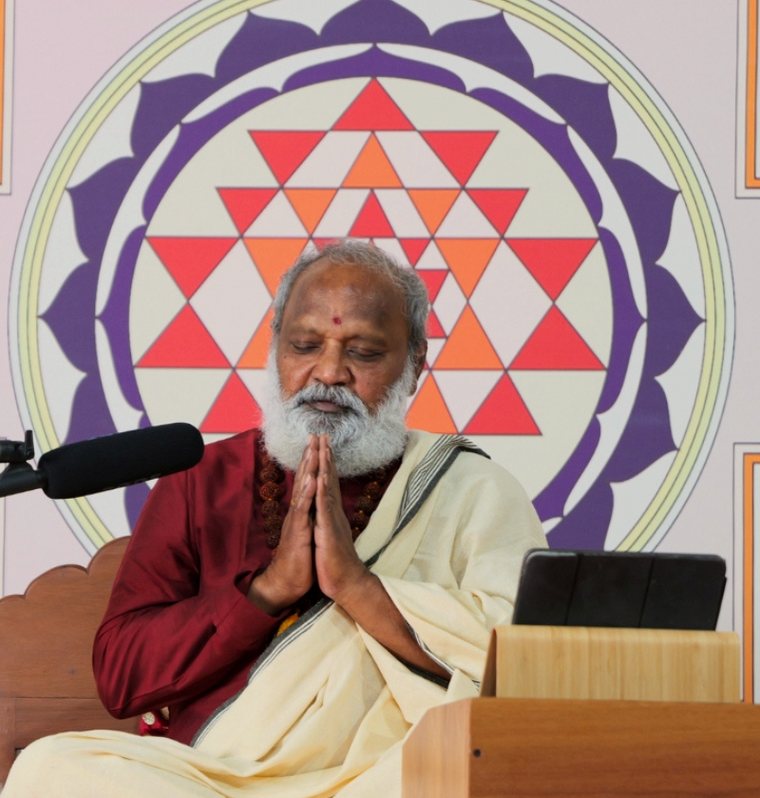
Each chakra has petals: four at the root, then six, ten, twelve and sixteen, two at the brow, and a thousand at the crown. The petals matter, Guruji says, because each centre is also a tattva, a principle of life. “If you hold to these tattvas and awaken them, realisation comes.”
Most of us live in four petals
The root centre, Muladhara, has four petals, and Guruji gives them a meaning everyone will recognise: a comfortable life. Earning money, a home, a family. “That is what everyone pursues, and they settle their life within it. They do not go above it.”
He puts it even more plainly when he speaks of the elements. Most of us live our whole lives in earth, water and fire, and never consciously touch air or space. “That’s roti, kapda, makaan,” he laughs: food, clothing, shelter. There is nothing wrong with any of it. It simply is not all you are.
How the petals wilt
Our actions and thoughts, he explains, come back to us as reactions. They gather in the aura and then, little by little, settle on the centres. Over months and years, the flower that was fresh in the morning begins to droop, and as the petals fade, the principle they carry fades with them.
The heart centre, Anahata, is his example of what is at stake. When it is awakened, a person becomes “very lovely, unconditional. He accepts everyone, and looks at others with an eye to help.” When it closes, the mind narrows and agitation grows.
You cannot plant a new one
What can be done? Here the flower turns hopeful.
We have to make it sprout again and set it right. You can’t pull it out and plant a new one; that would take another birth. So the chance is right here.
The spark
Each chakra has a root mantra of a single syllable. These are not secret, Guruji says; many people know them. “But only when it is given through deeksha does the vibration rise. Otherwise it stays at a normal frequency.” His image for this is a spark: “Only if you make the spark does the fire light.”
Through initiation the centre is awakened. Through daily practice it opens, and steadily develops. “It won’t happen in one day,” he says. “You have to keep doing it.”
Go step by step
Two cautions recur in his teaching. The crown, Sahasrara, the seat of what he calls Shiva consciousness, is not something to grasp at: “For now it should not be touched. You have to go from here,” from the base upward. And kundalini is never forced: “We don’t try to grab kundalini shakti directly. Nobody can. It causes disturbance.” On the Siddha path it rises gently, in its own time, as the practice matures.
That is why the path is taken in order, “like school, from the first class to the degree”. A flower is tended every day. So is this.
Guruji’s words are translated from Kannada, from his conversation on Manasa Sarovara with Gaurish Akki Studio.